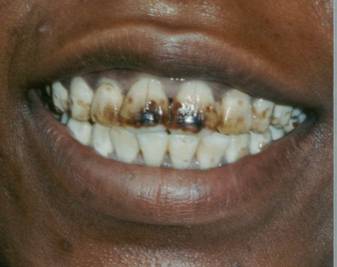
The earliest description of dental fluorosis stems from 1888 in USA, where immigrants from Durango, Mexico were reported to have “Black Teeth”. However, in fluorotic areas, fluorosis has probably been well known, even to common people. In many cases the layman also knew about the relation to “bad waters”. A 90 years old man in the Arusha region described the issue to the Author of this article in 1985 as follows:
Maji haya yana madini mengi, yanaharibu meno; Maji yenye madini kidogo, ni salama |
This water (Source) has a lot of minerals, it destroys the teeth, the other water (source) has only little minerals, it is safe. |
Then he added:
"Maji yenye ni safi, lakini si salama" |
That water is clear, but not safe |
The understanding of the difference between safi and salama, Clear and Safe, is still a major difficulty among many communities that are facing the fluorosis problem. Like that, in some parts of the Middle East, the “Black Teeth” are explained as a side effect of smoking and heavy tea/coffee drinking.
Today expressions like “Black Teeth”, “Smoker Teeth” and “Colorado Stains” are more rightly referred to as endemic fluorosis.
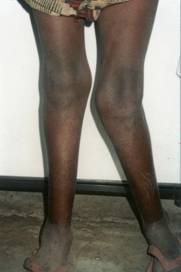
The term endemic fluorosis covers a wide variety of clinical manifestations of accumulative fluoride poisoning, mainly due to long-term consumption of relatively high concentration fluoride water. In mild cases fluorosis is observed as a more or less repulsive mottling of teeth , dental fluorosis . More severe cases are known as skeletal fluorosis including deformities like knock knees (genu varum), bowleg (genu valgum), antero-posterior bowing of tibia, humpback (kyphosis), exostosis and others.
Also non-skeletal fluorosis , including swollen joints, muscular tenderness, rheumatism-like pain especially in the joints, systematic rigidity, stiffness and impaired movement, all symptoms that give a feeling of rapid aging. Also gastric problems, burning sensation during urination, mental retardation and paraplegia, are reported as clinical manifestation of fluorosis.
Fluorosis may above all affect people socially and psychologically. Many fluorotic persons tend to hide there teeth and to constrain their smiles, and that may affect their personalities, their behaviour and their social potential for life time. This phenomenon is very well known in some regions and may be called “Psychological Fluorosis”. This type of fluorosis is still to be studied and quantified professionally.
Photographs from the original homepage
View the original archived article · WHO fluoride reference · Related research